
Shame
"I almost feel I am committing a sacrilege, replacing the sweet landscape of memory - by a far harsher one that strips it of all magic, but whose truth cannot be questioned, not even by memory."

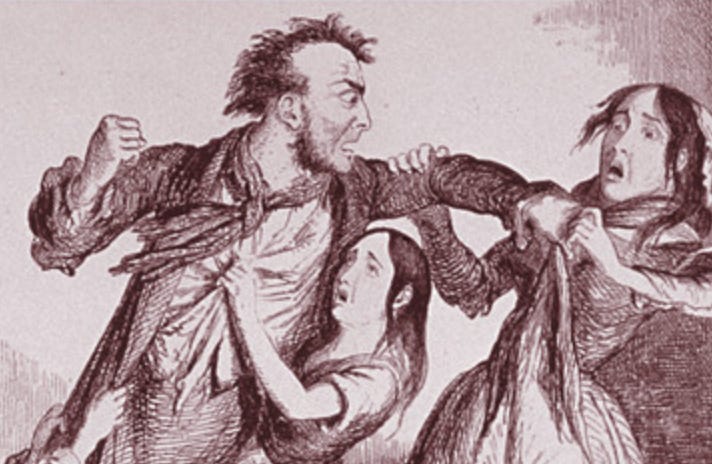
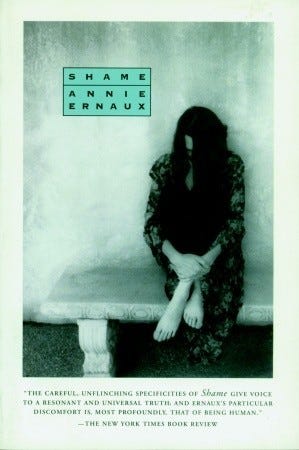
Shame—Ernaux’s eighth book, and first chronologically—is an attempt at reconciliation through material analysis. Though it can easily be read in a single sitting, Shame’s grounding in the material world lends it a sense of infinity. The book is concerned with an event from Ernaux’s childhood that serves not only as a watershed moment in the development of her consciousness, but also (she supposes) as the spark for her writing. This memory, of her father brandishing a knife at her nagging mother, is described in its entirety in the first few pages. All there is left to turn to afterward is the world in which this event occurred. Ernaux switches seamlessly between past and present tense when describing the landscape of her childhood. Through staring into the abyss of facts defining this landscape, summoned only to illuminate the event, these memories assume a quality of timelessness, as if the statements and truths that governed her childhood are still existing there, somewhere, whether in personal or collective memory, or in physical artifacts. The past is there still.
Ernaux writes how Proust saw memory as a thing outside humans, tied to recurrences in natural reality that produce memory within us. She examines how for herself and her contemporaries, memory is tied to that which is fleeting, such as products and fads—things that disappear, that don’t reoccur. Because of this, she feels stuck inside human history. She insinuates that we have lost the natural, earthly relationship to memory that Proust described.
I don’t totally believe we’ve lost it. Ancestral fears (memories) keep us away from dark spaces, flood us with flight or fright instincts that act independently of our rational, so called autonomous life. But then, my childhood (2000’s) lacks the material memory of Ernaux’s. Her generation was governed by ideals of progress and industry—mine was the result of this “progress”—a world doomed by climate change gone unchecked, nations declaring their right to supremacy, existence and omnipresence, as the globe tilted off course.
Unlike Ernaux, my childhood perspective did not perceive a culture proud of itself and its artifacts. In the winterly reoccurrence of crumbling roads the earthly memory came back to us out of the ruins of our supposedly stable artifacts. Concrete roses that bloomed in our minds. An uncanny awareness of the fragility of it all.
We understood that what we built was not meant to last.
Ernaux understands that her view is a limited one: she is unable to reconcile much by the end of the book. Its fixation on the material at times felt like a manifestation of her shame—the reader is treated to a quick gouging of truth at the beginning before Ernaux looks away, turns to gaze at the wall and catalogue its chinks. Shame is not a meditation on its theme, nor is it a journey towards reconciliation. Shame is a raw manifestation of Ernaux’s own shame—a shame produced by an internalization of the precepts of the world of her childhood. As shame does not often encourage one to gorge upon it, Ernaux’s shame had one large, all encompassing facet to turn to—the material world of her childhood out of which it emerged.
Wow! This is an amazing post.